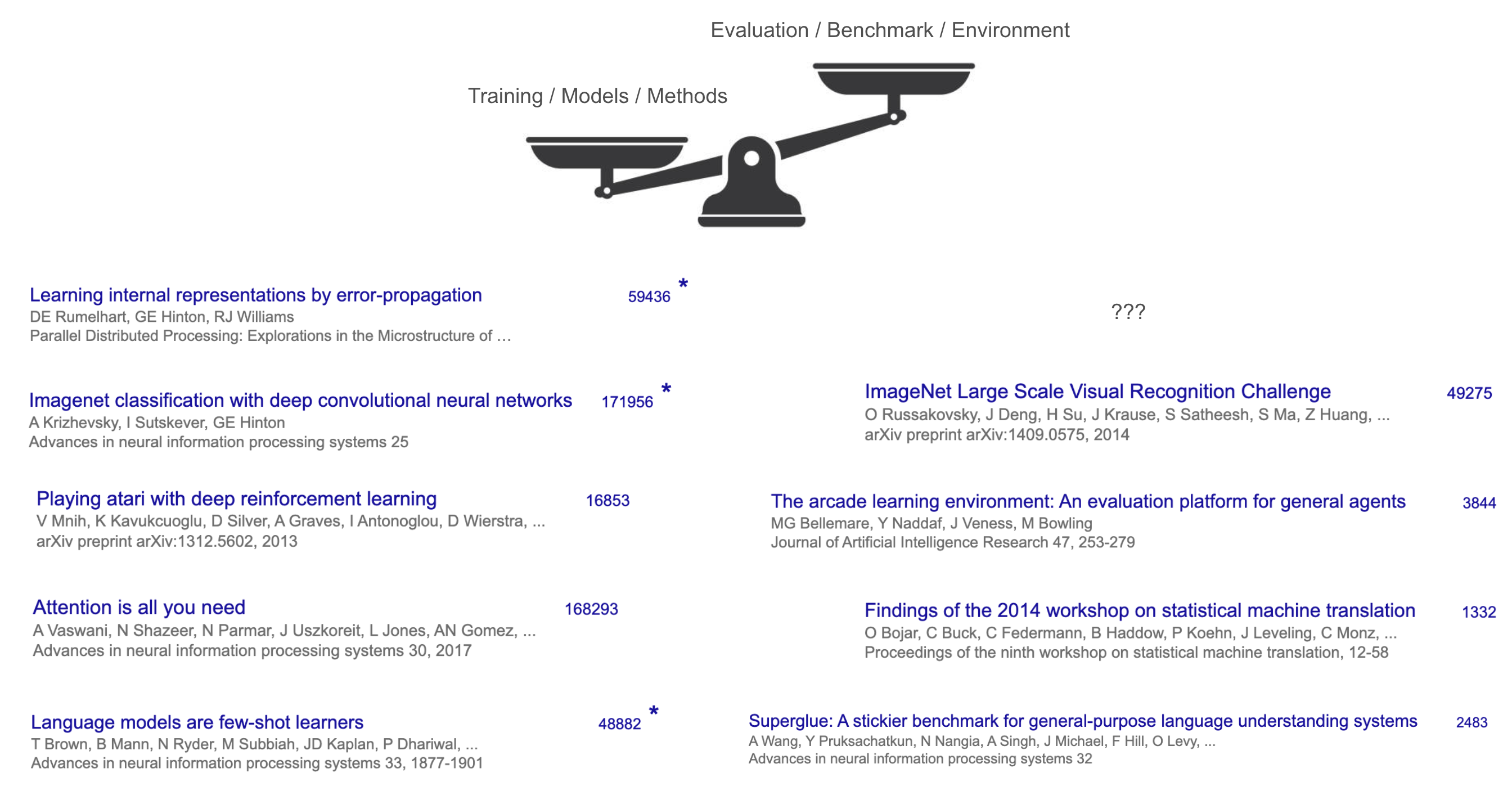
TL;DR: We're at AI's halftime. RL finally works and generalizes. The second half shifts from solving problems (training methods) to defining problems (evaluation). What we should train AI to do, and how we measure real progress, becomes more important than how we train it.
<aside>
tlldr: We're at AI's halftime.
For decades, AI has largely been about developing new training methods and models. And it worked: from beating world champions at chess and Go, surpassing most humans on the SAT and bar exams, to earning IMO and IOI gold medals. Behind these milestones in the history book — DeepBlue, AlphaGo, GPT-4, and the o-series — are fundamental innovations in AI methods: search, deep RL, scaling, and reasoning. Things just get better over time.
So what’s suddenly different now?
In three words: RL finally works. More precisely: RL finally generalizes. After several major detours and a culmination of milestones, we’ve landed on a working recipe to solve a wide range of RL tasks using language and reasoning. Even a year ago, if you told most AI researchers that a single recipe could tackle software engineering, creative writing, IMO-level math, mouse-and-keyboard manipulation, and long-form question answering — they’d laugh at your hallucinations. Each of these tasks is incredibly difficult and many researchers spend their entire PhDs focused on just one narrow slice.
Yet it happened.
So what comes next? The second half of AI — starting now — will shift focus from solving problems to defining problems. In this new era, evaluation becomes more important than training. Instead of just asking, “Can we train a model to solve X?”, we’re asking, “What should we be training AI to do, and how do we measure real progress?” To thrive in this second half, we’ll need a timely shift in mindset and skill set, ones perhaps closer to a product manager.
To make sense of the first half, look at its winners. What do you consider to be the most impactful AI papers so far?
I tried the quiz in Stanford 224N, and the answers were not surprising: Transformer, AlexNet, GPT-3, etc. What’s common about these papers? They propose some fundamental breakthroughs to train better models. But also, they managed to publish their papers by showing some (significant) improvements on some benchmarks.
There is a latent commonality though: these “winners” are all training methods or models, not benchmarks or tasks. Even arguably the most impactful benchmark of all, ImageNet, has less than one third of the citation of AlexNet. The contrast of method vs benchmark is even more drastic anywhere else —- for example, the main benchmark of Transformer is WMT’14, whose workshop report has ~1,300 citations, while Transformer had >160,000.
That illustrates the game of the first half: focus on building new models and methods, and evaluation and benchmark are secondary (although necessary to make the paper system work).
Why? A big reason is that, in the first half of AI, methods were harder and more exciting than tasks. Creating a new algorithm or model architecture from scratch – think of breakthroughs like the backpropagation algorithm, convolutional networks (AlexNet), or the Transformer used in GPT-3 – required remarkable insight and engineering. In contrast, defining tasks for AI often felt more straightforward: we simply took tasks humans already do (like translation, image recognition, or chess) and turned them into benchmarks. Not much insight or even engineering.
Methods also tended to be more general and widely applicable than individual tasks, making them especially valuable. For example, the Transformer architecture ended up powering progress in CV, NLP, RL, and many other domains – far beyond the single dataset (WMT’14 translation) where it first proved itself. A great new method can hillclimb many different benchmarks because it’s simple and general, thus the impact tends to go beyond an individual task.
This game has worked for decades and sparked world-changing ideas and breakthroughs, which manifested themselves by ever-increasing benchmark performances in various domains. Why would the game change at all? Because the cumulation of these ideas and breakthroughs have made a qualitative difference in creating a working recipe in solving tasks.